

Introduction
Most organizations aren't short on data. They're drowning in it. Spreadsheets, scanned records, sensor logs, customer histories — the volume keeps growing.
Yet AI and machine learning projects still stall constantly. The problem usually isn't a lack of data. It's that the data isn't actually usable by a model.
Data that worked fine for a quarterly BI dashboard often falls apart the moment you try to train an AI system on it.
Gartner predicts that through 2026, organizations will abandon 60% of AI projects that aren't backed by AI-ready data. That forecast is tied to data readiness, not general AI adoption struggles.
This guide breaks down what an AI-ready dataset actually is, why it matters more than most teams realize, the traits that separate it from "clean" data, and where to find or build one.
Key Takeaways
- AI-ready data needs accuracy, documentation, ethical sourcing, and machine-readable structure
- Poor governance and unrepresentative data stall AI projects and introduce bias
- Gartner: 63% of organizations lack or aren't sure they have the right data practices for AI
- Public and internal datasets both qualify as AI-ready when quality and governance standards are met
What Is an AI-Ready Dataset?
An AI-ready dataset is data that's accurate, complete, well-documented, ethically sourced, and structured for direct use by AI or ML systems. A data scientist shouldn't need weeks reformatting it first.
That last part matters. A dataset can look perfectly fine to a human and still be useless to a model.
Beyond FAIR: Why "Findable" Isn't Enough
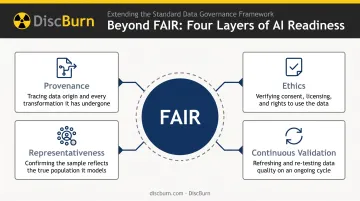
Many teams lean on the FAIR framework (Findable, Accessible, Interoperable, Reusable) as their readiness benchmark. FAIR is a solid foundation for machine actionability and rich metadata (Wilkinson et al., 2016). But FAIR was built for scientific data stewardship generally, not AI training specifically.
AI-readiness adds layers FAIR doesn't cover:
- Provenance — where the data came from and how it's been transformed
- Ethics — consent, licensing, and privacy compliance
- Representativeness — whether the sample reflects the population the model will serve
- Continuous validation — readiness isn't permanent; it has to be reassessed as use cases shift
Clean Data vs. AI-Ready Data
| Clean Data | AI-Ready Data |
|---|---|
| Accurate, deduplicated | Accurate, plus contextual and governed |
| Complete records | Complete, with documented gaps explained |
| No standard metadata requirement | Requires schemas, metadata, and lineage |
| One-time cleanup | Requires ongoing validation |
Readiness also isn't binary. A dataset might score well on accuracy but poorly on documentation or bias mitigation. Treat it as a checklist rather than a pass/fail test.
A labeled CSV file with a documented schema, clear metadata, and known provenance is AI-ready. A folder of scanned PDFs with no consistent structure is not — even if every scan is perfectly legible.
Why AI-Ready Datasets Matter
The old rule still applies: garbage in, garbage out. Except now the "garbage" doesn't just skew a report — it gets baked directly into a model's behavior at scale.
Gartner's 2025 research found that 63% of organizations either lack the right data-management practices for AI or aren't sure they have them. Most teams are still building on uncertain ground.
Bias Doesn't Announce Itself
Unrepresentative training data produces inaccurate models—and discriminatory ones.
NIST's 2019 Face Recognition Vendor Test evaluated 189 algorithms from 99 developers. False-positive rates for Asian and African American faces were often 10 to 100 times higher than for Caucasian faces, depending on the algorithm. NIST couldn't pin a single cause on every system, but non-representative training samples kept showing up.
That's exactly why demographic and distributional checks matter before training, not after deployment.
Time-to-Value and Regulatory Stakes
Data scientists routinely report spending the majority of a project's timeline cleaning and reconciling data before any model training even begins. AI-ready data flips that ratio.
Compliance raises the stakes further. The EU AI Act (Regulation 2024/1689) requires high-risk AI systems to use training data governed for the intended purpose, including:
- Documented data origin
- Bias examination
- Representativeness checks
Non-compliance with provider obligations can trigger fines up to €15 million or 3% of worldwide annual turnover, whichever is higher. General applicability begins in August 2026, with sector-specific rules phasing in through 2028.
Core Characteristics of an AI-Ready Dataset
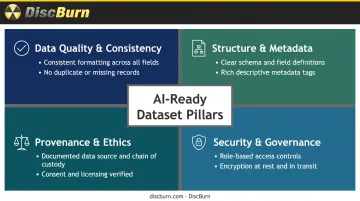
Readiness breaks down into four practical categories. A dataset doesn't need to be perfect across all four — but weak spots should be known, not hidden.
Data Quality, Completeness, and Consistency
Missing values, duplicate records, and outdated entries are the most common issues teams underestimate. Left unresolved, they cause model drift once a system moves from testing into production.
Consistency across historical and live data matters just as much as accuracy at any single point in time.
Structure, Metadata, and Machine-Actionability
A dataset needs a stable schema, clear variable definitions, and rich metadata so an ML pipeline can ingest it without manual rework. Documentation of units, encodings, and missing-value patterns helps both humans and algorithms interpret the data correctly. That documentation is sometimes called pre-model explainability.
Provenance, Ethics, and Bias Mitigation
Provenance tracks where data came from, how it's been transformed, and which version is in use. It's essential for debugging model errors and passing audits later.
Ethical sourcing — consent, licensing, privacy — and representative sampling aren't optional extras. Skip them, and bias gets embedded before training even starts.
Security and Governance
Sensitive fields need to be discovered, classified, and protected through encryption, masking, or access controls across the entire AI lifecycle. NIST's AI Risk Management Framework specifically flags data poisoning and training-data exfiltration as active security risks (NIST AI RMF 1.0).
Clear stewardship roles keep governance from becoming a one-time checklist that nobody revisits.
Where to Find AI-Ready Datasets
Not every project needs a dataset built from scratch. Several public and institutional sources already offer curated, documented data:
| Source Type | Examples |
|---|---|
| Government/statistical portals | World Bank Open Data, U.S. Census Bureau, U.K. ONS |
| Academic/research repositories | UCI Machine Learning Repository (689 datasets) |
| ML-specific platforms | Hugging Face Datasets, Kaggle |
| Cloud provider exchanges | AWS Data Exchange, BigQuery public datasets, Azure Open Datasets |
These platforms are a strong starting point. "Publicly available" doesn't automatically mean ready for your model. Before using any external dataset:
- Check documentation for known gaps or collection methodology
- Confirm the licensing terms permit your intended use
- Verify metadata quality matches what your pipeline expects
- Assess whether the sample represents your actual target population
Preparing and Distributing Your Own AI-Ready Data
Sometimes the right dataset simply doesn't exist externally. Building your own follows a fairly predictable path:
- Audit existing data for quality gaps: missing fields, duplicates, inconsistent formats
- Standardize metadata and documentation so the schema is stable and self-explanatory
- Apply de-identification and privacy safeguards where personal or sensitive data is involved
- Validate representativeness against your actual target population before training
Loop in domain experts and data stewards early. Automated checks catch missing values fine. They're far worse at spotting subtle mislabeling or context that only someone familiar with the domain would recognize.
The Physical Distribution Problem
Once a dataset is cleaned, labeled, and documented, getting it to the people who need it isn't always as simple as uploading it. Healthcare organizations, corporate compliance programs, and research partnerships often work with air-gapped systems, bandwidth constraints, or strict data-handling policies that rule out network transfer entirely.
This is where physical media still earns its place. DiscBurn's custom-printed USB drives and SD/Micro SD/Compact Flash duplication give organizations a way to package large or sensitive AI training datasets and ship them directly to field teams or research partners:
- Capacities from 512MB to 128GB on USB drives, with custom sizes available
- Offline MD5 verification in an air-gapped Ubuntu environment to confirm copies match the source master
- REACH/RoHS-compliant NAND in consumer, commercial, or industrial grades for regulated procurement
- USB-C, Micro USB, and standard USB connectors for compatibility with older field equipment
- 3-business-day standard turnaround, with 24-hour rush on select drives

For teams retiring source devices after data extraction, DiscBurn's data sterilization service provides documented chain-of-custody and destruction confirmation when original media must be disposed of securely.
Keep a versioned backup of the finalized dataset regardless of how it's distributed. Reproducible training runs depend on knowing exactly which version of the data produced which model.
Frequently Asked Questions
What is an AI-ready dataset?
It's data that's accurate, well-documented, ethically sourced, and structured for direct use by AI or ML systems. It goes beyond basic "clean data" standards by adding governance, provenance, and machine-readability requirements.
Where can I get datasets for AI?
Public repositories like Kaggle, Hugging Face, UCI Machine Learning Repository, and government open data portals are strong starting points. Internally curated organizational data is often just as valuable, provided it meets quality standards.
What's the difference between "clean data" and "AI-ready data"?
Clean data is accurate and complete. AI-ready data adds structure, rich metadata, governance, and ongoing validation so machines, not just humans, can interpret it correctly.
How do you know if a dataset is biased or unrepresentative?
Compare the dataset's demographic and distributional characteristics against your actual target population. Review the original data collection methods for gaps or skewed sampling.
Do AI-ready datasets need to be labeled?
Labeling is essential for supervised learning tasks, but not universally required. Many unsupervised or generative use cases work with unlabeled AI-ready data.
How much does poor data quality cost AI projects?
Poor data quality drives rework, delayed launches, and failed models—often the largest hidden cost in AI programs. Gartner predicts that through 2026, 60% of AI projects will be abandoned due to a lack of AI-ready data.