But drop that consumer card into a dash cam running 24/7, or a controller sitting in an unheated warehouse through a Minnesota winter, and the cracks show fast. Many businesses unknowingly deploy consumer-grade cards in dash cams, surveillance systems, and industrial controllers — and pay for it later with corrupted footage, frozen playback, and emergency reboots at the worst possible time.
This guide breaks down what actually makes a card "industrial grade," the four official SD capacity standards, how NAND flash type drives reliability, where these cards get used, and how to choose (and source) the right one for your project.
Key Takeaways
- Industrial cards differ from consumer cards in temperature range, write endurance, error correction, and locked component lists
- Four capacity standards (SDSC, SDHC, SDXC, SDUC) set different maximum sizes and file systems
- NAND flash type (SLC, pSLC, MLC, TLC) is the single biggest factor in reliability and cost
- Weigh endurance, certifications, and compatibility together—not the lowest sticker price
What Is an Industrial SD Card?
An industrial SD or microSD card is a storage device engineered for continuous operation in conditions that would degrade or kill a consumer card within months. Consumer cards are built for occasional use: a few hundred photos, a weekend of video, then a long rest in a drawer. Industrial cards are built to run nonstop, often in places nobody planned to check on for years.
Temperature range is the clearest sign of the gap. Kingston's industrial-grade microSD line is rated for operation from -40°C to 85°C, while extended-duty variants from other manufacturers commonly cover -25°C to 85°C. That range matters for outdoor cameras, vehicle telematics, and aviation electronics that see temperature swings a phone never will.
Another defining trait is the locked Bill of Materials. Manufacturers freeze the exact NAND chip and controller pairing under one fixed product number. Order the same part number in year one or year three, and you get identical internal components — no silent substitutions, no surprise firmware quirks after a "routine" reorder.
Industrial cards also build in reliability mechanisms consumer cards typically skip:
- Error Correction Code (ECC) that detects and repairs bit errors during read/write operations
- Automatic read-refresh that rewrites data showing early signs of degradation before it becomes unreadable
- Sudden Power-Off Recovery (SPOR) that protects the file system and committed data if power cuts out mid-write
- Health-monitoring telemetry that tracks wear, bad blocks, and estimated remaining life
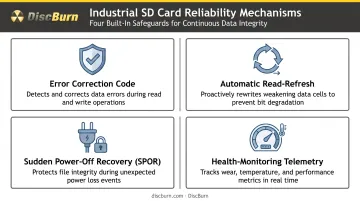
Because industrial and consumer cards look and mount identically, the entire difference lives inside the card and in the manufacturer's testing documentation. That makes vendor sourcing — not visual inspection — the real decision point.
The Four Types of SD Cards by Storage Capacity
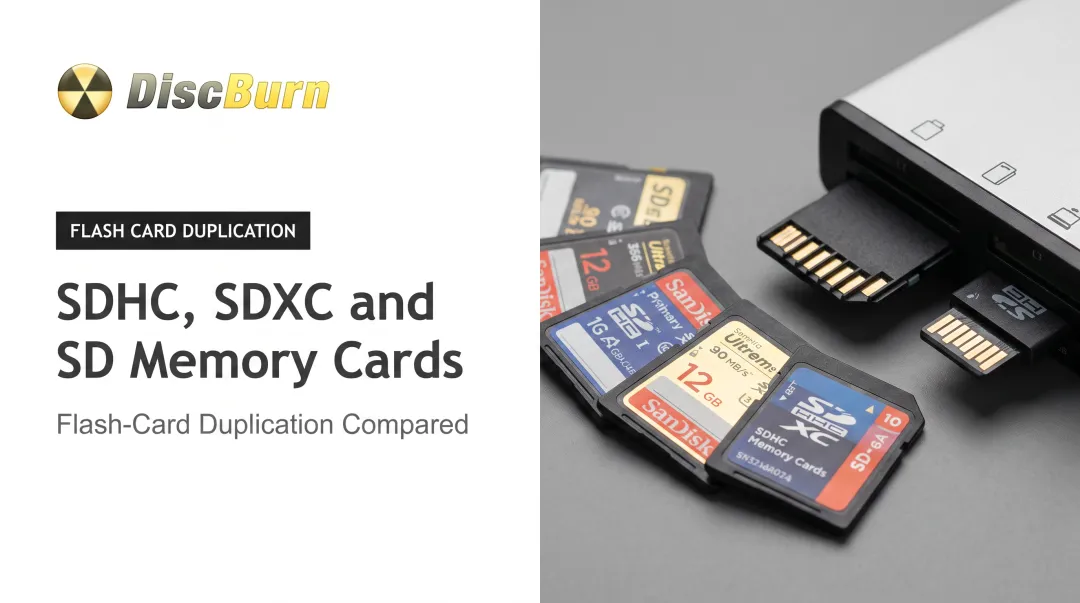
SD cards fall into four official capacity families defined by the SD Association. Speed and durability aside, capacity alone determines which family a card belongs to.
| Standard | Maximum Capacity | Default File System |
|---|---|---|
| SDSC | Up to 2GB | FAT12/FAT16 |
| SDHC | Over 2GB to 32GB | FAT32 |
| SDXC | Over 32GB to 2TB | exFAT |
| SDUC | Over 2TB to 128TB | exFAT |
These classifications apply equally to full-size SD and microSD form factors. The physical size doesn't change the capacity rules. In practice, industrial-grade cards cluster in the SDHC and SDXC ranges, since most embedded and surveillance applications don't need SDUC-level capacity.
Capacity standard, speed class, and industrial grade are three separate specifications. A card can be SDXC-rated, slow, and consumer-grade all at once. Check all three before you buy, not just the capacity printed on the label.
NAND Flash Grades: The Real Difference Behind Industrial Reliability
If temperature range is the visible sign of an industrial card, NAND flash type is the engine underneath. It's the single biggest factor separating a card that survives five years of continuous writes from one that dies in five months.
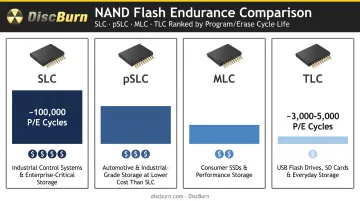
SLC (Single-Level Cell) stores one bit per cell. It's the most durable and most expensive option, reserved for applications where failure simply isn't an option: aviation black boxes or mission-critical industrial logging.
pSLC (pseudo-SLC) takes standard MLC or TLC NAND and runs it in single-bit mode, sacrificing capacity for a major endurance boost. Kingston's testing shows SLC-mode NAND rated around 100,000 program/erase cycles compared with roughly 3,000-5,000 for standard TLC. That gap translates directly into years of extra service life under heavy write loads.
MLC (2 bits/cell) and TLC (3 bits/cell) sit below SLC in raw endurance. Industrial-grade versions still outperform their consumer equivalents thanks to tighter manufacturing tolerances and firmware tuned for sustained writes rather than occasional bursts.
| NAND Type | Relative Endurance | Relative Cost | Best-Fit Use Case |
|---|---|---|---|
| SLC | Highest | Highest (roughly 10x TLC) | Mission-critical, extreme-duty logging |
| pSLC | High | Moderate (roughly 3x TLC) | Continuous recording, industrial controllers |
| MLC | Moderate | Moderate | General industrial embedded use |
| TLC | Lower | Lowest | Light-duty or capacity-priority applications |
Choosing the right NAND grade is a total-cost decision. Higher-endurance cards cost more per unit, but they cut the downtime, data loss, and replacement labor that drive real ownership costs over the full lifecycle.
Where Industrial SD and MicroSD Cards Are Used
Industrial cards show up anywhere a device needs to write data continuously without a technician standing by to swap out a failed card. Common deployments include:
- Dash cams and DVRs running loop recording around the clock
- Security and surveillance cameras capturing footage 24/7
- Medical monitoring devices logging patient data continuously
- Industrial automation and PLCs recording sensor and process data
- Rail and aviation systems operating in shock, vibration, and temperature extremes
- Networking and telecom equipment requiring long-term data logging
Continuous read/write applications are where the endurance gap shows up fastest. ATP's testing on high-endurance cards estimates that a 128GB card can handle roughly 99,000 hours of continuous HD recording before reaching end of life, a figure that drops sharply for 4K footage or mixed, random-write surveillance workloads.
Consumer cards, built around occasional writes rather than sustained overwrite cycles, simply weren't designed for that math.
Industrial microSD cards are also becoming standard in embedded systems and IoT devices, including single-board computers where the card functions as primary, non-removable storage rather than swappable media. In those setups, a card failure means a field service call, not a quick swap. That raises the stakes on getting the grade right from the start.
How to Choose the Right Industrial SD Card for Your Application
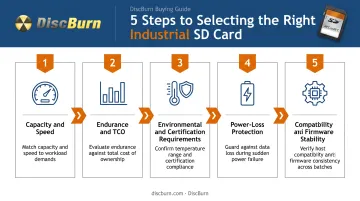
Picking an industrial card comes down to matching specifications to how the device actually behaves in the field, not defaulting to whichever card is cheapest per gigabyte.
- Capacity and speed. Match storage size and speed class (C, U, or V ratings) to your data type and volume. Continuous 4K video needs a higher sustained write speed than periodic sensor logging.
- Endurance and total cost of ownership. Compare P/E cycle ratings and projected lifespan against the device's real duty cycle. A card rated for light use will fail early in a 24/7 application, regardless of price.
- Environmental and certification requirements. Confirm temperature range, shock/vibration tolerance, and certifications (such as ISO 9001, IEC 60529, or AEC-Q100) match your real deployment conditions.
- Power-loss protection. Verify the card includes SPOR or an equivalent safeguard, particularly for safety-related systems where sudden power loss is a realistic scenario.
- Compatibility and firmware stability. Test cards on your exact host hardware before mass deployment. Favor vendors offering a locked BOM so component substitutions don't quietly change performance mid-production run.
Bulk Sourcing and Data Preloading
Specifying the right card is only half the job. Organizations rolling out hundreds or thousands of pre-configured cards (firmware images, training content, embedded software) face a separate challenge: loading and verifying that data accurately at scale without tying up in-house IT staff for weeks.
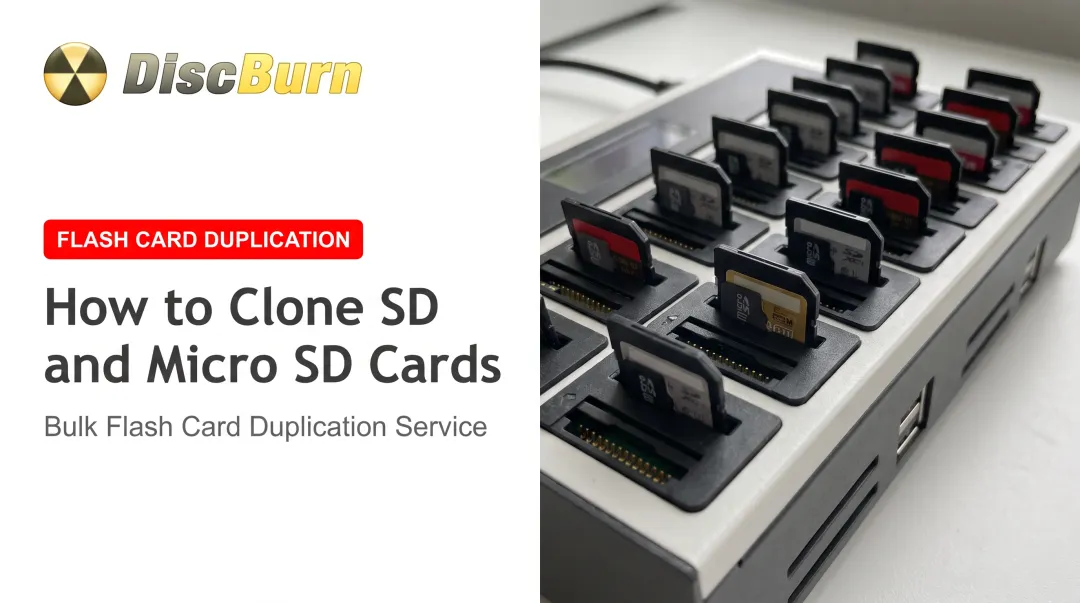
A specialized duplication partner handles that load so your team does not. DiscBurn duplicates SD, microSD, miniSD, and Compact Flash cards in-house in Minneapolis, with every batch verified before it ships:
- Binary-level duplication for file-level data and bootable-card builds
- Custom full-color labeling applied directly to each card
- Pricing from $15 per unit (card included), with data loading from 4GB and volume tiers for larger runs
- Standard three-business-day turnaround
For industrial-grade cards or larger custom volumes, confirm sourcing and pricing at 612-782-8200.
Frequently Asked Questions
What is an industrial grade SD card?
An industrial-grade SD card is a ruggedized card built for extended temperature range, higher write endurance, built-in error correction, and a locked component list for consistent performance. Consumer-grade cards aren't built to the same standards for harsh or continuous-use environments.
What are the four types of SD cards?
The four official capacity standards are SDSC (up to 2GB), SDHC (up to 32GB), SDXC (up to 2TB), and SDUC (up to 128TB). Each uses a different default file system, from FAT16 up through exFAT.
How long do industrial SD cards typically last?
Lifespan depends on the card's program/erase (P/E) cycle rating, NAND grade, and how heavily the device writes data. Check the manufacturer's endurance specs and use built-in health-monitoring data to plan replacement before failure.
Can a consumer SD card be used in an industrial application?
Technically yes, but it carries real risk. Consumer cards lack the error correction (ECC) and temperature tolerance industrial applications need, making premature failure likely under continuous or extreme-environment use.
What temperature range can industrial SD cards withstand?
Most industrial cards operate reliably from -25°C to 85°C, with extended-duty models rated as low as -40°C to 85°C. Always confirm the exact range against your deployment environment.
Does DiscBurn offer bulk SD card duplication for industrial projects?
Yes. DiscBurn duplicates SD and microSD cards with verified data loading and custom labeling. Pricing starts at $15 per unit including the card. Call 612-782-8200 for industrial-grade sourcing and volume pricing.